
Nippon Kodo – Sandalwood (Mainichi Koh and Kayuragi)
In this article I’m combining the reviews of two sandalwood sticks from Nippon Kodo: Mainichi koh (which are also sold under the name Viva Sandalwood) and Kayuragi – Sandalwood.
I got Mainichikoh sent from Steve. In his review, he dug deeper into the history of Nippon Kodo and particularly of Mainichi Koh; it’s very worth reading.
The samples of Sandalwood out of the Kayuragi line come from my friend Povilas.

Mainichi Koh – Sandalwood
‘Mainichikoh’ means something like incense for daily use, often simply referred to as ‘everyday incense’.
This picture from Steve shows both a large pack of the Mainichi Koh variant and a Viva Sandalwood roll.
Apart from this comment on Reddit, everything indicates that the two are the same sticks in different packaging.
The large yellow boxes seem to be intended rather for the Japanese domestic market, and the rolls for export. Nevertheless, you find the large boxes in shops outside Japan, e.g. on the US site of Nippon Kodo ($11 for a box with 150 sticks) or a shop called Japancom.de (€19 for 300 sticks).
The sticks of both packaging variants measure 14cm and burn for about 30 minutes.
Packaged as rolls, though, I’ve also found a long variant with 22cm and a burning time of 55 minutes.
The raw scent of Mainichi Koh Sandalwood reminds me of some sandalwood soaps, and I find it somewhat old-fashioned, as if it were a fragrance I’d known from my grandmother.
The smell when burning is similar. It isn’t exactly soapy but has a perfumed character that recalls sandalwood to some degree, but doesn’t really hit the mark for me.
The aroma is moderately sweet and creamy, with a freshness reminiscent of cosmetic products.
Joining this is a slightly pungent note that reminds me of the pine or fir fragrance of some German incense cones.
Additionally, I smell a faint, cardboard-like smoke smell, which probably comes from the base material.
I hardly believe you can expect more for 6 cents per stick on the European market, but I’d rather pay a little more if that gets incense sticks which don’t smell like perfumed sawdust.

Kayuragi – Sandalwood
Kayuragi are a comparatively higher-quality line from Nippon Kodo. The sticks come in packs of 40, with a length of 14cm. They’re packaged in a paulownia wood box that slides inside a cardboard sleeve. The burning time is approximately 25 minutes.
On the German market, a pack costs about €17; that makes approximately €0.42 per stick.
The most affordable offer I’ve found comes from Ongnamo, at €16.20.
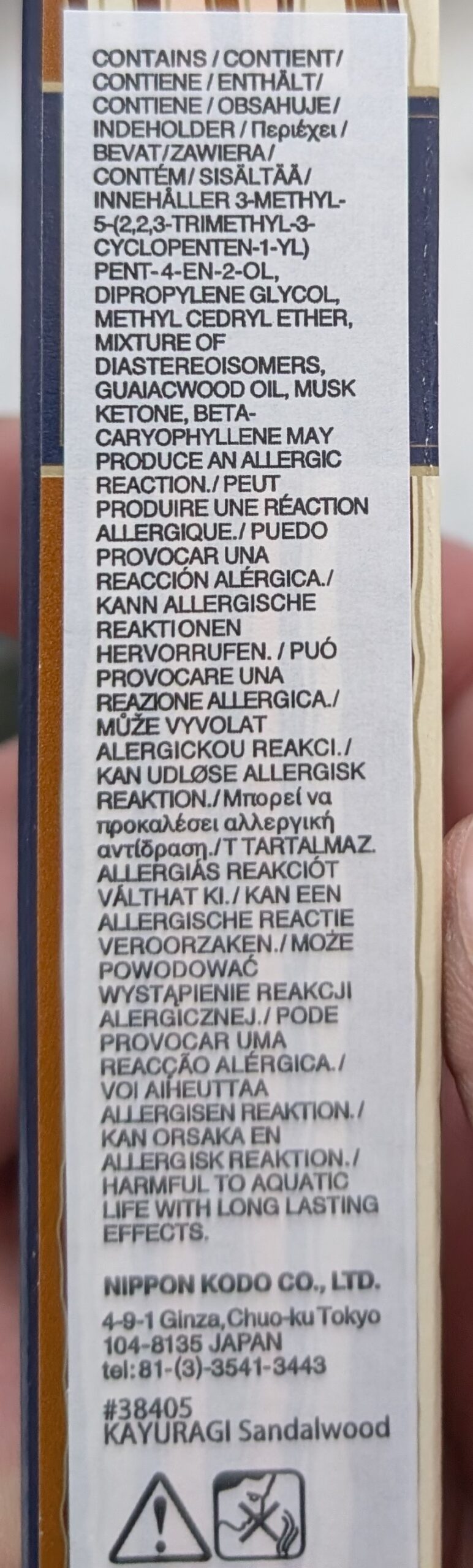
Povilas, from whom I’ve got these samples, has provided me with a picture of the back, on which there’s a sticker that informs about potentially allergy-triggering ingredients:
3-METHYL-5-(2,2,3-TRIMETHYL-3-CYCLOPENTEN-1-YL) PENT-4-EN-2-OL, DIPROPYLENE GLYCOL, METHYL CEDRYL ETHER, MIXTURE OF DIASTEREOISOMERS, GUAIACWOOD OIL, MUSK KETONE, BETA-CARYOPHYLLENE
In the raw scent, Kayuragi – Sandalwood have quite a clear camphor note. Added to that is a typical sandalwood smell and a few other notes that I can’t place.
In Kayuragi – Sandalwood I again find a hint of a note reminiscent of cosmetic products, but it’s minimal. It strikes me most strongly when I stand a little too close to the burning stick.
The composition is mainly of powdery, woody fragrance, interwoven with a sweet softness. I find the scent quite typical for sandalwood.
The camphor (or in Japanese incense sticks rather borneol) is much less apparent when burning than in the raw scent, but nevertheless makes itself noticeable once in a while. It forms a cool counterpoint to the general warmth of the fragrance.
Unlike many varieties from Nippon Kodo, these Kayuragi don’t have an unpleasant base smell for me, which does make me curious to try other fragrances of that line.
The after-smell lasts a bit longer than I’m used to from Japanese sticks.
I like Kayuragi – Sandalwood and find they belong to the better sandalwood sticks from Nippon Kodo, as far as the more affordable lines are concerned.
It doesn’t bother me that synthetic fragrances are used here to emphasise the natural fragrance of the sandalwood. But I can well understand that not everyone wants to expose themselves to a substance like musk ketone, which is suspected of being carcinogenic. Therefore, I welcome the transparency that the sticker on the back of the pack offers.
The details of this list should be a reminder to everyone not to blindly trust the good reputation of Japanese incense sticks to be ‘entirely natural’.
I’ve always wondered why certain sandalwood incense sticks are dyed green.
I also really enjoyed the Kayuragi Sandalwood, but is it ever powerful! I had to quarantine my box so that the fragrance didn’t taint the rest of my collection.
Good reminder on the “natural” reputation of Japanese incense also. Making incense has shown me just how preposterous this idea is. You can’t tell me that Tennendo Kyara, or Gyokushodo Suzaku is made entirely from natural materials; there’s just no way you’d get that kind of projection.