
Namaste India (Orkay) – Earth Inspired – Palo Santo with Lemongrass
I received this thick stick from Steve; you’ll find his review here.
Ephra World Shop sells packets with 30g or 10 sticks for €3.80.

The sticks measure 8″ (approximately 20.5cm),
of which 7cm (almost 3″) are bare bamboo.
On the Indian website of Namaste India (a sub-brand of Orkay) you only find Palo Santo with Lemongrass when searching for ‘lemongrass’; Palo Santo isn’t mentioned in the title nor the description; it really only appears as a term in the name on the packaging.
They’re available to buy there in double packs for ₹180 (not quite €1.80). The burning time is given as 40 minutes. (Ephra states 90-100 minutes, which absolutely doesn’t work out.)
Namaste India also state on the product page that all their incense sticks are free from charcoal.
I’m showing you a close-up of the stick where I’ve scraped off some of the coating, and I’ll leave it to you whether you consider that credible:
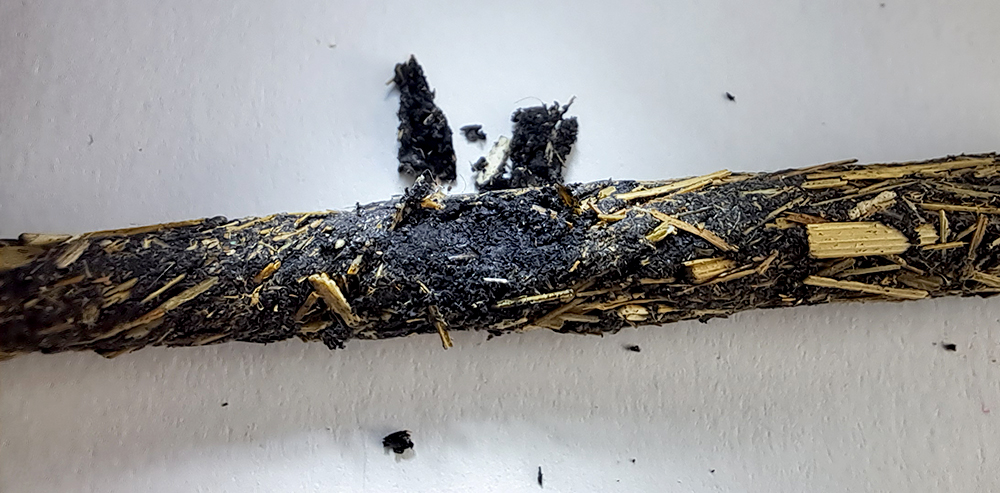
The sticks are coated with (quote) ‘real lemongrass’. It’s faded and mostly quite woody, so rather from the lower ends of the leaves.
I lit some of the loose bits and found they have no lemongrass aroma whatsoever, but have soaked up the sticks’ perfume. Thus, the coating appears to be purely cosmetic.
The fragrance of Palo Santo with Lemongrass is particularly sweet; it’s a warm, balsamic-soft and ambery sweetness that strongly reminds me of the base smell of many Fiore D’Oriente sticks. I actually even find a hint of a sandalwood fragrance, which brings a powdery feel into the composition.
It thereby has similarity to some ‘loban’ fragrances that combine benzoin resin with other resins and perfume.
It takes 2-3 minutes until the lemongrass fragrance finally joins in. It’s clearly the smell of an oil, not of actual lemongrass: a heady, fresh-citrusy fragrance that combines extremely well with the warm, soft sweetness.
I find the fragrance really captivating and lovely; Palo Santo with Lemongrass is a lemongrass for sweet noses.
I can’t find the smallest trace of Palo Santo, though.
Note
In the description text by Namaste India the term ‘essential oil’ is carefully avoided; instead one reads of lemongrass ‘fragrance’, which usually means fragrance oils, i.e. synthetic or semi-synthetic fragrances. Apart from the ‘real lemongrass’ of the coating, no ingredients are named.
At the end of July, I inquired with Namaste India whether
- these sticks contain Palo Santo in any form (which I strongly doubt)
- the sticks contain essential oils, fragrance oils or both, and
- what would explain the black colour of the sticks, if not charcoal.
I received no response. If this changes, I’ll update this article accordingly.
Namaste India promise: ‘These high-quality agarbatti are raw, organic and beautiful, just like Mother Earth’.
In my eyes (or rather my nose), these are quite typical, very modern, charcoal-based ‘masala’ incense sticks whose smell is predominantly based on oils (which has little to do with the original idea of masala, which was a mixture of ground, aromatic ingredients).
They’re made to look rustic and ‘raw’ to cater to the current trend of thick, natural-looking incense sticks, but I consider that pure masquerade.
I find the fragrance of Palo Santo with Lemongrass genuinely delicious, but the marketing rubs me the wrong way.
I have seen all these smudge stick and they all appear to have the same herb thingy rolled onto the stick. I will agree to this point that it is for show. I’m now getting into lemongrass incenses, will try this.
Looking forward to reading about your impression of these sticks, especially since Steve and I experienced it so differently.
I have reviewed one of these sticks- Pradhan Tantra Rosa and I have found it ok. I will be reviewing the Tulasi’s Blissful Botanics Sandalwood and Banjara ones that Steve sent me to review.