
Fiore D’Oriente – Marco Polo’s Treasures – Palo Santo
I bought Palo Santo together with three other Marco Polo’s Treasures varieties from Spiru.
It looks like the company drastically changed its sales concept shortly after my last purchase and switched the shop to a sort of subscription service that now only operates within the Netherlands.
Palo Santo had cost €5.95 there. It’s a 20g pack with 10 sticks of 9″ (23cm) length.
At Ephra World they cost €6.45, but they’re currently sold out.
Padma Store offers them for €6.95 and at the Fiore D’Oriente shop, a pack costs €4.90.
The sticks are 9″ (approximately 23cm) long and burn for at least an hour.
In some pictures on the internet, the packs are shown with the ECOCERT seal, but my pack has the ICEA emblem instead on the back.
Here you can find my overview article about the Marco Polo’s Treasures line.
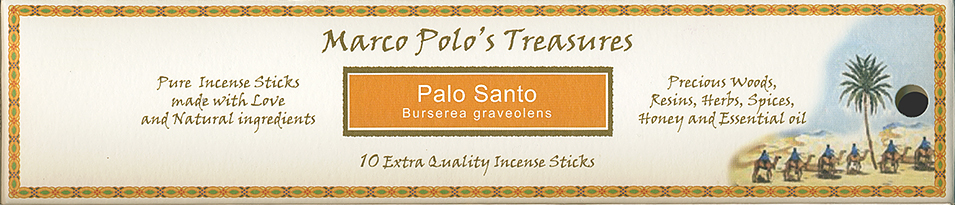

Ingredients: Bursera graveolens, Machilus macrantha gum, charcoal powder, bamboo
With these incense sticks from Fiore D’Oriente, we’ve got a second example of Palo Santo sticks produced in India that actually smell like Palo Santo. However, unlike Divine Palo by PremaNature, these aren’t available in India.
Palo Santo by Fiore D’Oriente have an authentic Palo Santo wood scent, which is rather on the dry and less sweet side of the spectrum. Possibly, one of the ingredients from the base contributes to this.
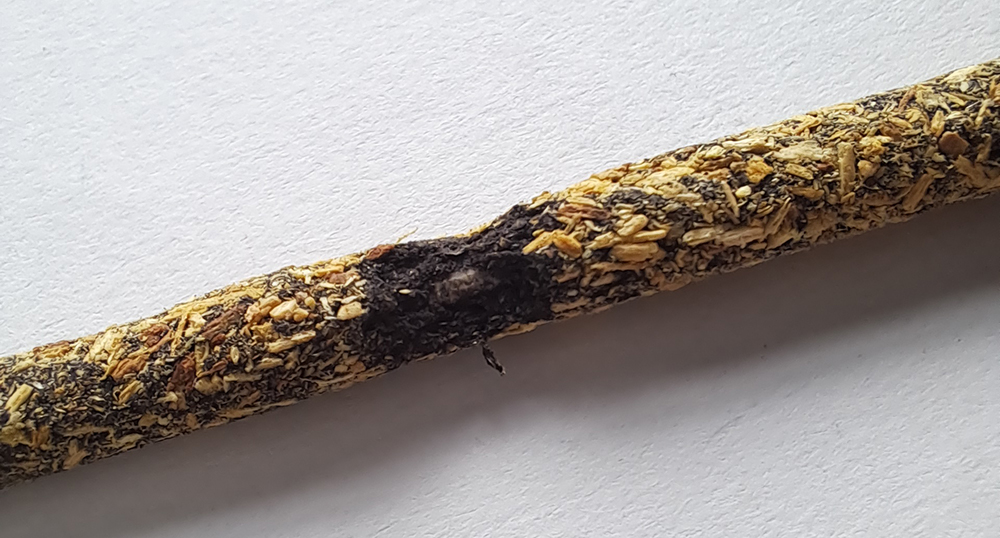
Whilst the sticks are rather generously coated with Palo Santo wood splinters, it’s hard to say how high the proportion of it actually is in the incense dough. On the inside, the sticks are almost black. Judged by the short ingredients list and the scent, it should, however, be a decent amount.
Alongside the dry wood note, I smell a good amount of the not untypical rubber scent of Palo Santo wood, which I unfortunately find a bit too prominent here. It gives the scent a certain bitterness that’s too intense for my liking.
Marco Polo’s Treasures – Palo Santo isn’t bad, but of the options produced in India, I’d prefer the ones made by PremaNature.
Worldwide, there’s a larger selection of good Palo Santo incense sticks, for example:
Two variants by Jiri & Friends; then there’s Ispalla, whose sticks are generally made using a base of Palo Santo wood, and Jeomra’s (aka Mothersgoods) for an option made in Germany.