
Sagrada Madre – Tao Black: Riqueza, Energia Reconfortante, Paz Interior
I got one stick each of these three varieties of the Tao Black line by Sagrada Madre from Steve. I’m linking his reviews in the section of the respective varieties.
As far as I know, there’s no source for these sticks in Germany. Steve ordered them from a shop called hostenatura.es in Spain.
A pack with 5 sticks costs €3.50 there; they’re approx. 23cm long.
The sticks all look the same, which is why I’ve only scanned one of them:

The carrier sticks are rectangular and about 2.5 x 1.5mm thick.
The dough application is uneven, rough and brittle; it seems to be a mixture of charcoal powder, coarsely ground ingredients and a binding agent.
It’s possible that these are made by alternately dipping the wooden sticks (I think it’s wood, not bamboo) into liquid binding agent and then sprinkling them with the ground ingredients. This would explain the structure. I don’t think you could achieve this through hand-rolling.
The lower ends of some sticks give a further clue:
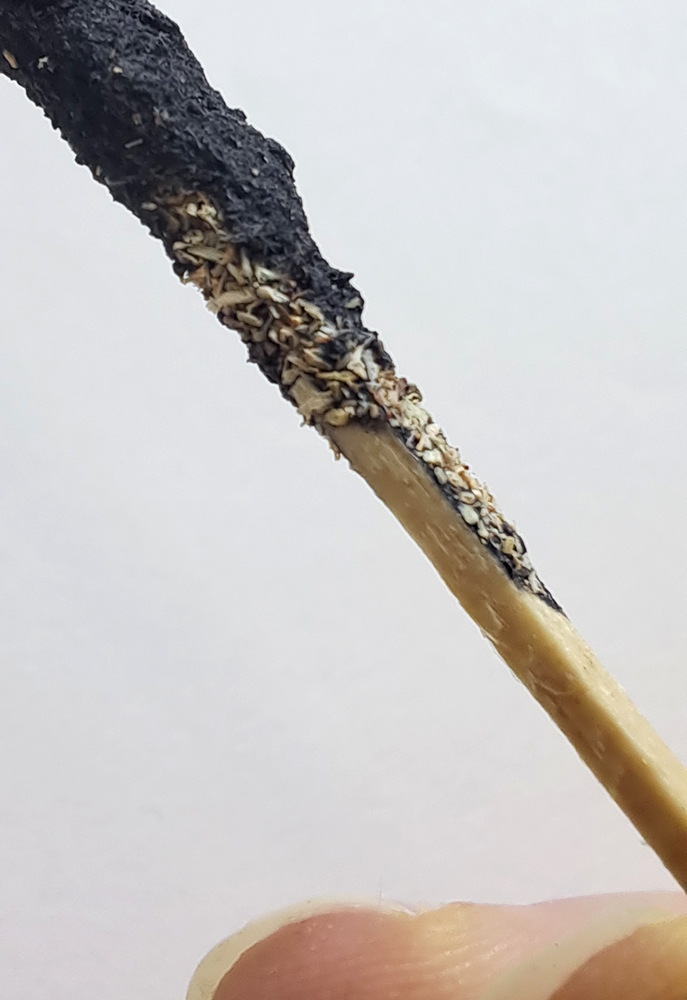
It looks as if the last dip didn’t entirely cover the layer of coarse powder. This detail also makes me suspect that the charcoal dust is mixed in the liquid component. This would allow the charcoal to be ground very finely and distributed more evenly.
If it were in the dry powder mixture, the fine dust would eventually settle at the bottom.
In the picture, you can also see the slightly frayed fibres of the stick, as typical with sawn wood.
Riqueza (Wealth)
The description on this page says Riqueza contains ‘concentrated Ratnamala oil: Ratnamala, an aromatic resin, is known for its properties of attracting luck and prosperity.’
I’ve tried to find out what Rathnamala could be. The description of other incense sticks states it means ‘string of pearls’ and is associated with wealth, which would fit the theme of this variety. Steve has also settled for this answer.
There’s even a ready-made perfume oil for incense stick production with the name. However, I couldn’t find a plant or resin with the name Rathnamala.
The raw stick smells florally sweet, in a perfumed, slightly soapy way.
Lit, I find the fragrance even a little more soapy than before, but basically, it’s the same aroma.
The smell is dominated by the wood smoke of the wooden core, or perhaps also the combustible material with which the sticks are coated. It looks like coarsely ground wood. Perhaps it’s simply sawdust soaked in perfume oil.
After I’ve smelt the burning stick, I’ve no more doubt that the cores are wood and not bamboo. It smells a bit like when blowing out a match.
In the after-smell, the unpleasant and pungent wood smoke dissipates and leaves behind a vague, creamy sweetness.
You can find Steve’s review here.
Energia Reconfortante (Calming Energy)
‘Pure vanilla essence: Vanilla, known for its relaxing properties, is the main component of this incense stick and creates a sweet and enveloping fragrance.’
The raw stick smells of vanilla flavouring with a slight touch of body lotion or similar.
Energia Reconfortante don’t have as pungent a smoke note as Riqueza, but do also smell of smoke.
The vanilla aroma is quite weak. It manages to come through and is quite pleasant, but probably only because it’s so subtle. If it were stronger, it would most likely be cloying.
If I go closer to the burning stick, the smoke smell is stronger, but the aroma isn’t.
Enegia Reconfortante are unobtrusive, as long as you’re not bothered by the smoke smell.
Here is Steve’s review. Energia Reconfortante got the highest rating of these three from him: 23 (out of 50 points).
Paz Interior (Inner Peace)
‘The linden blossom, known for its calming and relaxing properties, is the main component of this incense and provides a soft, floral fragrance.’
I love the fragrance of blooming linden trees; it’s one of my favourite floral fragrances.
Of course, I’ve tried to use them for incense, but like most flowers, linden blossoms don’t smell particularly good when burned.
As far as I know, you can’t distil essential oil from linden blossoms, but absolutes are possible. However, I doubt that an expensive absolute is used here.
I’ve got a linden fragrance oil that comes quite close to the smell of the blooming tree. The raw scent of these sticks is different, though; drier and a bit soapy. Actually, I was quite surprised to read that Paz Interior is supposed to be linden fragrance.
This stick was slightly harder to get going than the others. Perhaps because it’s a bit thicker than the others.
The fragrance is pretty much identical to the raw scent, but a little stronger, with a greater emphasis on the soapy and dry character of the fragrance.
The smell isn’t really unpleasant, but absolutely not my taste.
As with Riqueza, a relatively strong smoke note comes with it. I find that not quite as pungent as with Riqueza; perhaps it’s due to the stick’s thickness that improves the ratio of incense material to core. It could be that the aroma also comes through somewhat more strongly because of that. But perhaps they’re also just stronger perfumed.
Closer to the burning stick, where the smell is still quite concentrated, the perfume also seems more intense, denser and rather unpleasant.
Only the after-smell provides a fragrance which I can actually recognise as linden blossom.
Here‘s Steve’s review of Paz Interior.
Conclusion
The rustic look is super trendy right now. The marketing is primarily aiming for a spiritually interested customer base. Sticks of this kind are currently sprouting like mushrooms, and the quality seems overall quite mixed.
Once again, an effort is made to imply naturalness, and once again, it’s strikingly unconvincing.
Steve mentions that Sangrada Madre mainly produce ‘resin-on-a-stick’-style incense sticks, but like him, I come to the conclusion that Tao Black are dipped, charcoal-based incense sticks that contain some coarse sawdust to create the rustic appearance. I doubt that these sticks contain resin. Nothing about the smell suggests it, and the smoke output is (despite the strong smoke smell) quite low.
I became aware of Sagrada Madre a few years ago, but the style has never appealed to me and the relatively high price hasn’t made it better. This video on Instagram put me off even more.
From the perspective of a blogger, I’m nevertheless curious about the (supposedly) higher-quality offerings from Sagrada Madre, but I have to confess that it’s rather a morbid curiosity that drives me. I want to know whether their stuff is actually as bad as I anticipate.
In any case, I cannot recommend Tao Black.
“The rustic look is super trendy right now. The marketing is primarily aiming for a spiritually interested customer base.”
This trend is driving me nuts! Instagram reels of people rolling incense sticks in jasmine petals, globbing shmoo onto chunks of palo santo, et cetera, all with hundreds of likes of course, while I’m thinking to myself: ‘there’s no way this smells good’. I can’t wait until these companies / makers learn that natural, spiritual, and witchy things can also be *good*. They don’t have to be terrible as a rule!