
New Age Imports: Code 1995, Storax Balm, Black Copal
New Age Imports is a US-American import company that (according to Incense In the Wind) has these incense sticks made for them by Native Americans. On their website they’re listed under ‘Resin Incense Sticks’.
The line is sold, for example, by Exotic Incense. That’s also where Steve ordered them, who sent me these samples. His reviews can be found here.
Each pack contains 6 sticks and costs $5. The burn time for the 11″ (~28cm) long sticks is given as about an hour.
Steve seems to have shortened the bamboo of my samples. They’re only about 9″ (22cm) long, but look completely normal.
It seems to be a popular tactic among US manufacturers to sell extra-long incense sticks (and market them as such – Wild Berry, I’m looking at you), where only the bamboo core is longer, but the paste coating it isn’t.
The first time, I tried these three varieties outside on my balcony. For writing the review, I’m now burning them in my living room.

Code 1995 Thousand Aromas
Code 1995 seems to refer to the company’s founding year. New Age Imports write: “this special New Age Smudges & Herbs blend has captivated hearts with its symphony of natural herbs and botanicals” and claim “therapeutic and mood-enhancing properties”. 🤨
As top notes they list jasmine and gardenia; heart notes are patchouli and rose. Base notes are vanilla, lavender, coconut, cinnamon and sandalwood.
The cold throw is quite intense and perfumey: sweet, floral and slightly tangy, with a soapy, tart note. It reminds me of reed diffusers, but also of one of the bakhoors I sampled at the end of last year.
The burning stick is hard for me to bear, and I only let it burn for a brief moment in my living.
The smell is super perfumey in an artificial, obtrusive way. To me, it doesn’t smell like something that was meant to be burned.
It’s simply unpleasant, and I strongly doubt that this scent is ‘natural’, as they claim. I don’t know what the base is made of, but the bulk of the aroma definitely comes from some kind of perfume. The inside of the sticks is black as coal. I wouldn’t be surprised if they were dipped incense sticks.

Storax Balm
Here too it’s claimed that the ingredients are natural. The description reads: “Storax is a resin that has been used for centuries for its medicinal and aromatic properties. It has a warm, sweet, and slightly musky scent that is said to promote feelings of peace and tranquility.”
Storax is a balsamic resin from various Liquidambar trees. There’s a variety native to America, called ‘American storax’ or ‘American sweetgum’, scientifically Liquidambar styraciflua.
The resin is liquid like honey, and is very potent. If you smell the pure resin, it’s reminiscent of gasoline. Only diluted does it unfold a soft, sweet, slightly vanilla-like and floral scent.
The styrax commonly found in shops consists of resin-soaked charcoal bits. It’s claimed that even these are often adulterated with synthetic fragrances, or contain no real styrax at all.
The pure resin is rarely found in shops and relatively expensive.
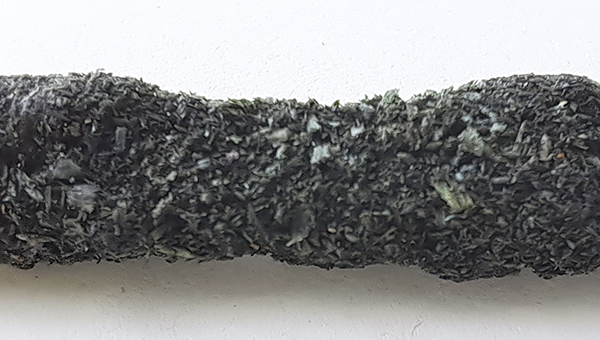
The paste of the stick is crumbly and oddly light.
The cold throw has a certain overlap with some styrax incenses I know, in that it smells sweet and balsamic, but it doesn’t really smell like styrax; I wouldn’t recognise it as such. It’s sweeter in way (or sweet in a different way), and the smell is perfumey and a little soapy.
The aroma of the burning stick is rather restrained at first. Once the smell has built up a bit in the room, aside from a faint, balsamic sweetness, I only notice a smoky off-note that reminds me of coal and wet cardboard.
I can’t say I find the aroma particularly artificial or unpleasant, it’s just not good or interesting, and it doesn’t smell like styrax either.

Black Copal
The raw stick smells resinous-tart, but has also picked up a good amount of the perfumey smell of the surrounding incense sticks.
The stick is coated with coarse resin dust.
If there’s any resin in the paste, it can’t be much. The smell reveals a generally resinous character, but beyond that doesn’t have much profile. It smells of resin, but not necessarily of any particular one. I’ve had ‘frankincense’ incense sticks before that smelled roughly the same.
The resin smell is accompanied by that of the base; it comes across as a mix of charcoal and sawdust. This is also still quite noticeable in the after-smell.
Among this selection, though, Black Copal is still a bright spot.
Conclusion:
The sticks may be visually appealing, but scent-wise I find them rather subpar. The fact that they’re produced in the US (and allegedly by American natives) doesn’t lend them any distinctive character. They could just as easily have been imported from India.