
Bhagwan Incense – Kerala Garden, Monsoon Incense – Kerala Flower and Temple Of Incense – Kerala Flower
I received both Bhagwan – Kerala Garden and Monsoon – Kerala Flower as samples in January of this year (2025) from Eugene Andrushchenko, the owner of both brands.
Kerala Garden is available for €4.95 – a 15g packet should contain 8 sticks, which makes approximately €0.62 per piece. The sticks are 8″ (approximately 20.5cm) long.
Kerala Flower costs €2.50, also for 15g or approximately 8 sticks; these measure 9″ (approximately 23cm) though. The stick price amounts to approximately €0.31.
I received the sample stick of Temple Of Incense – Kerala Flower at the end of 2023 from Sascha, the owner of Indiaroma.
In the Temple Of Incense (UK) shop, a packet with 20 sticks costs £10; at Indiaroma in Germany it’s €12. So you pay about €0.60 per stick.
With the name ‘Kerala Flower’ one is tempted to assume that it’s a specific flower, but it’s apparently more of a fantasy fragrance; a homage to Kerala – a state of India – and its lush landscapes.
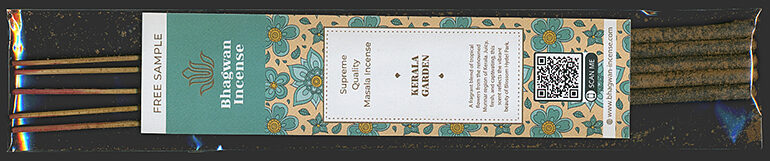
Bhagwan Incense – Kerala Garden
Kerala Garden has a particularly intense, floral bouquet. Apart from the lush sweetness of roses, it’s impossible for me to pick out any specific flowers. This olfactory sea of blossoms comes in combination with a strong, both tangy and tart freshness, which I believe to be bergamot. It forms a lovely contrast to the rose sweetness.
Between these two main aspects, I find both creamy and powdery notes, accompanied by a touch of musk.
In the after-smell, the fragrance transforms to appear somewhat more fruity and the creamy sweetness comes more to the foreground.

Monsoon Incense – Kerala Flower
Kerala Flower turns out to be even more tangy-fresh than Kerala Garden, but a little less tart and with a tad bit more musk.
The citrusy aspect reminds me less specifically of bergamot than generally of citrus fruits.
Although I also find this fragrance strongly floral, I can’t name anything specific.
The fragrance seems a bit simpler; less complex than the other two, which doesn’t hurt it, though.
Perhaps it’s because Kerala Flower is less tart than Kerala Garden, I find their fragrance brighter and lighter in a way, more easygoing – more accessible, perhaps.
The quality of their sweetness is also a little different. Not so lush and creamy, but more fruity instead.
The after-smell equates to a milder version of the fragrance when burning.

Temple Of Incense – Kerala Flower
The single stick wasn’t quite enough for me to write an in-depth review, but I thought it’s nevertheless interesting to briefly outline it here.
The fragrance is tangy-floral, with a certain tartness, but the composition is overall quite round and sedate (but not weak), whereas I perceive that of the other two varieties as high-pitched and lively in comparison.
In this Kerala Flower too is a tone that I find citrusy, but this is more restrained than with the others, especially than in the Monsoon variant.
The similarity between TOI and Bhagwan is greatest, I only found TOI a tiny bit more tart and less sweet, with the tangy-floral, bergamot-reminiscent freshness further in the background.
Conclusion
All three of the varieties discussed here remind me of Balaji – Red, which were my first encounter with this kind of fragrance. Today, I think what I described as ‘grapefruit peel’ back then could be bergamot. Another olfactory kinship is Koya’s Rasta.
None of these fragrances really suit my taste, but I can absolutely understand why people are wildly enthusiastic about fragrance profiles like these. They’re multi-faceted, interesting fragrances full of character.