
Yichen · 易塵
Yichen contacted me at the end of 2025 via Instagram.
The company is based in Zhongshan City, Guangdong Province, in southern China. It’s a family business that has been active in the incense sector for three generations.
I’ll add a section below where I report on my experience with Yichen. But I want to keep the main focus on the incense; this article will be long enough as it is. Those interested are welcome to click here.
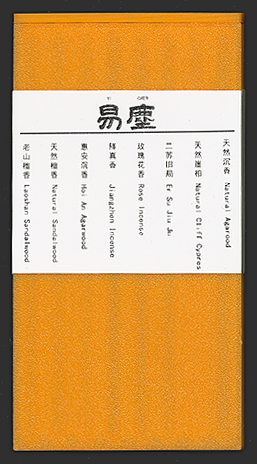
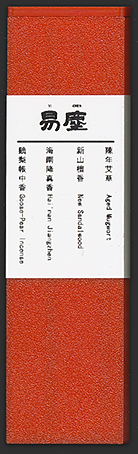
The sticks in the Sample-Sets are each approximately 9-10cm long. In the shop, a length of 18-21cm is given for the regular packs. So you’re getting roughly one regular stick as a sample.
Two varieties contained 3 samples (so one and a half normal sticks).
The yellow set with 8 varieties costs $10 (€8.77), the red one with 4 varieties costs $6 (€5.26).
The packaging is a very sturdy 3D print, though its lid doesn’t hold quite reliably.
You’ll see in the pictures below that a couple of the sticks are broken; this didn’t happen during transport, but when removing the sticks from the case. Due to the groove structure of the print, the sticks sometimes don’t come out smoothly; you have to shake or tap gently, and if you’re not careful enough, they easily break.
Since the samplers each contain at least two varieties of Sandalwood, Agarwood and Jiangzhen, there’s a comparison of the different varieties further below for better overview. (The links lead to the respective sections.)
Sample Set 1 (Yellow, 8 Varieties)

Natural Agarwood · 天然沉香
Ingredients: agarwood, nanmu
Price: ~ $31 (approximately €27) for 20-30 sticks of 18-21cm length.
Since I found Natural Sandalwood rather disappointing, I didn’t expect much from Natural Agarwood. But I’ve done the sticks an injustice; they’re actually good.
The approximately 1.5mm thick sticks are fragile, which could be an indication that as little binder as possible was used.
The raw scent is a weak, warm-woody tone.
The fragrance when burning has a typical agarwood character, with a balsamic, sweet, warm note. Overall, the smell is rather woody and dark. Occasionally, an association to mild pipe tobacco arises.
In one session, I noted a somewhat scratchy wood smoke note, of which I wasn’t sure whether it came from the quality of the wood or perhaps from the binder. Turning on my mini-fan helped.
I find Natural Agarwood overall quite round and pleasant. The quickly burning sticks, however, have barely been enough for me to get more than a first impression.

Natural Cliff Cypress · 天然崖柏
Ingredients: cliff cypress, nanmu
Price: ~ $28 (approximately €24.50) for 20-30 sticks between 18 and 21cm length.
I suspect cliff cypress is what others sell under the name ‘Thuja’: Thuja sutchuenensis.
The sticks open with a classic woody-dry smell that reminds me of fireplace smoke or campfires. Over time, though, a more characteristic smell builds up, which exhibits the typical green and mineral freshness of thuja incense sticks.
I’ve compared Natural Cliff Cypress with the Thuja sticks from Pinny Culture and Zeetoon that I reviewed last year and have to say that Yichen’s version has a clearer and more defined character.
The sticks are very light, ‘soft’ and surprisingly flexible. They burn relatively quickly.

Er Su Jiu Ju · 二苏旧局
Ingredients: agarwood, sandalwood, amber, frankincense, jasmine
Price: ~ $20 (approximately €17.50) for 30-40 sticks of 21cm length.
Er Su Jiu Ju are the only sticks in the shop where a specific length is given.
When Yichen use ‘amber’, they mean pine resin, as I was told upon enquiry.
According to Yichen, this is apparently often called 琥珀 (‘amber’) in Chinese incense jargon, although the actual Chinese term is 松脂. The latter is translated by Google Translator as ‘rosin’. Rosin is the solid, resinous material that remains after steam distillation of resins. So their ‘pine resin’ could also be colophony.
Like Goose-Pear Pavilion, the sticks are only 1mm thick and there’s a certain similarity in fragrance as well.
Already the raw scent has a similar character: woody and sweetly fresh, with a hint of resin and a slightly floral note.
Every time I light one of the sticks, the first thing I smell are off-notes similar to cigarette smoke or the burnt smell that many herbs and flowers give off when burning.
It takes almost a minute before this settles and the actual aroma cores through. Then the smell is quite lovely and actually rather similar to the raw scent. Unfortunately, a trace of the burnt note flairs up again in between.
It smells like a less potent version of Goose-Pear Pavilion from the red sample set; less resinous, but with a very subtle fruity-floral note.
I recently burned Tobiume by Baieido and reminded me a bit of Er Su Jiu Ju. It’s a shame I can’t compare the two any more.
Despite the small diameter, the burning time of these sticks is noticeably longer than most other varieties, which is probably due to the resins.

Rose · 玫瑰花香
Ingredients: sandalwood, rose flower petals, amber, nanmu, cliff cypress
When Yichen use ‘amber’, they mean pine resin, as I was told upon enquiry.
According to Yichen, this is apparently often called 琥珀 (‘amber’) in Chinese incense jargon, although the actual Chinese term is 松脂. The latter is translated by Google Translator as ‘rosin’. Rosin is the solid, resinous material that remains after steam distillation of resins. So their ‘pine resin’ could simply be ‘colophony‘.
Price: ~ $23 (approximately €20) for 20-30 sticks between 18 and 21cm.
The raw scent of these rose sticks is rather inconspicuous but does remind of dried rose petals.
Unfortunately, there’s nothing of the rose fragrance left in the burning sticks. The smell is powdery and soft, with a hay-like sweetness, but also has a strong off-note that’s typical of burning plant material like petals. It simply smells burnt.
Over time, the burnt smell decreases and a rather generic-woody note mixes in underneath. Sometimes I think I can pick out a bit of the cypress wood.
The sandalwood listed as an ingredient must be the same as in Natural Sandalwood, which I describe below.
I find the after-smell unpleasant, if not very strong.

Jiangzhen Incense · 降真香
Ingredients: jiangzhen wood, nanmu
Price: ~ $23 (approximately €20) for 20-30 sticks between 18 and 21cm.
Jiangzhen Incense (called Natural Jiangzhen Incense on the website) has a dark-woody smell for me. It triggers a diffuse déjà vu: the smell of an antique piece of furniture, I see noble, dark wood before my inner eye…
There’s a spicy note that’s a bit pungent, and a faint, almost medicinal smell.
With the second sample, I also perceive a subtle sweetness and I like the smell better than the first time.

Hoi An Agarwood · 惠安沉香
Ingredients: agarwood, nanmu [the description text calls it an ‘agarwood blend’.]
Price: ~ $39 (approximately €34) for 20-30 sticks of 18-21cm length.
These agarwood sticks (written ‘Hui’an Agarwood‘ on the website) have a spicy smell, or this interesting pungent note of certain agarwoods, that can sometimes appear as green. I’ve smelt it (albeit much more pronounced) in different ‘Kinam’ incenses.
It mixes here with a gentle, dry wood smell and is accompanied by a balanced sweetness.
I find Hoi An Agarwood quite characterful but unobtrusive.
The sticks are fragile and burn quickly.

Natural Sandalwood · 天然檀香
No ingredients are given for Natural Sandalwood, only a list of things that it doesn’t contain.
Price: ~ $23.50 (approximately €20.60) for 20-30 sticks of 18-21cm length.
The smell is described as ‘deeply woody, soft, with a naturally sweet undertone’.
What exactly ‘Natural Sandalwood’, is, is not revealed.
I always find such namings odd; it raises the question of how much more natural this sandalwood is than that of the other varieties, especially since Yichen emphasise the naturalness of the ingredients in all their products anyway.
I smell very little softness in the smell. It’s woody, the way incense made from light cedar wood also smells woody; with a slight pungency if it hasn’t diluted strongly enough in the air.
It has the character of rather inexpensive sandalwood; I find no sweetness.

Laoshan Sandalwood · 老山檀香
There’s no ingredients list for Laoshan Sandalwood, but the description states that ‘Laoshan Sandalwood’ is used in the sticks, which usually means sandalwood from India.
Price: ~ $28 (approximately €24.50) for 20-30 sticks of 18-21cm length.
These sticks have the milky-soft sweetness you’d expect from Indian, or specifically Mysore sandalwood. The smell has a relatively strong woodiness with slight spice.
It’s a classic sandalwood fragrance.
Sample Set 2 (Red, 4 Varieties)

Aged Mugwort · 陳年艾草
Ingredients: mugwort, cypress, nanmu
Price: ~ $15 (approximately €13) for 30-40 sticks of 210cm length.
With mugwort, I’d have expected a strong bitter note even in the raw scent, but quite the opposite: the fragrance of the raw sticks is surprisingly sweet, almost floral; it reminds me of mild herbal tea.
Lit, you’re immediately greeted by the familiar tart to bitter herbal smell. The aroma is robust, earthy-herbal, but not harsh. The sticks lack the quickly arising burnt off-notes of burning greenery; it’s a remarkably ‘clean’ herbal fragrance.
Even when burning, there’s still a hint of the sweetness initially noticed.
Mugwort (and tart herbal fragrances in general) aren’t a genre I feel drawn to, but Mugwort have nevertheless impressed me.

New Sandalwood · 新山檀香
Ingredients: sandalwood, nanmu
Price: ~ $13 (approximately €11.40) for 20-30 sticks of 18-21cm length.
The description reveals that ‘New Sandalwood’ refers to sandalwood from newer sources of cultivated sandalwood. It also states that compared to ‘Old Mountain Sandalwood’ (which usually means Indian sandalwood), it has a lighter fragrance with fresher aroma and delicate woody notes.
The light, yellowish colour suggests it won’t be Australian sandalwood (Santalum spicatum), however ‘white’ sandalwood (Santalum album) is also cultivated in Australia.
Another, perhaps more plausible, source for this sandalwood is Indonesia, where Santalum album and variants of it occur naturally and are also cultivated.
The smell of these sticks is quite full and clearly recognisable as sandalwood. It has little sweetness, but instead has the almost salty or sour, buttery-soft character of some sandalwoods.
It’s a full, woody smell, underlaid with a very fine spiciness.

Hai’nan Jiangzhen · 海南降真香
Ingredients: jiangzhen wood, nanmu
Price: ~ $37.50 (approximately €33) for 20-30 sticks between 18 and 21cm.
The description in the Yichen shop doesn’t reveal how Hai’nan Jiangzhen and Jiangzhen Incense (in the yellow sampler) differ.
Upon enquiry, I was told that Hai’nan Jiangzhen wood comes specifically from the Hainan region in China, whilst the other jiangzhen comes from various regions. The wood from Hainan Jiangzhen is much higher quality and smells distinctly different.
Hai’nan Jiangzhen has a rather fascinating fragrance. Even the raw scent is unusual: sour, waxy and medicinal.
When I light a stick, I smell (as with the other version) a dark, woody note that reminds me of antique furniture, but this isn’t the dominant note here.
An unusual sweetness strikes immediately; I’d roughly place it between honey and styrax balsam, including a pinch of the pungent note that pure styrax has.
Added to this is a surprising florality. It vaguely reminds me of lilac or also lilies: a heavy, sweet blossom fragrance.
Sometimes, the smell also reminds me of pipe tobacco, but not the smoke. It’s more like the smell that lingers in an empty packet.
Hai’nan Jiangzhen has a lot of character; it’s an unusual fragrance that you won’t find in common incense sticks.

Goose-Pear Pavilion · 鵝梨帳中香
In the sampler, the variety is labelled ‘Goose-Pear Incense‘, on the website it’s called ‘Goose-Pear Pavilion‘.
Ingredients: The AI-generated image giving the ingredients speaks of agarwood, sandalwood and pear, showing the image of an actual pear with it. However, Goose Pear incense is made with ‘goose pear’, which is actually a type of quince.
In the description text you read ‘This blend typically contains agarwood, sandalwood, clove, frankincense and other soft herbs […]’
I inquired because of the discrepancy.
Regarding the AI image, I was only told: ‘AI is not correct 😅 do not trust that.’ So Yichen are advising me not to trust the AI image they themselves use in their product description. Splendid. 😐
My question about the correct ingredients was answered very evasively. They only said ‘mostly sandalwood, agarwood and pear’.
Price: ~ $23 for 30-40 sticks of 18-21cm length.
These sticks are strikingly thinly extruded; the diameter is only one millimetre.
The fragrance differs drastically from all the ‘Goose Pear’ incenses I’ve tried so far, and in an extremely unexpected way:
Even after the fourth try, my nose interprets the smell as a relatively typical ‘Three Kings’ concept, characterised by a blend of frankincense, myrrh and benzoin. About 2 years ago, I started playing around with this blend, both as loose incense and in the form of sticks. I made one variant with (Australian) sandalwood as a base; the smell of Goose-Pear Pavilion reminds me exactly of those (though without a recognisable myrrh note, which mine have).
The base of the fragrance is woody, but it has a distinctly resinous note that combines with a strong sweetness, which I can’t help but interpret as frankincense and benzoin.
I’ve searched for a smell I can link with agarwood, but I kept landing back at the three kings.
Beyond that, there’s a fine floral note that I can’t name.
The fragrance of Goose-Pear Pavilion is lovely. It feels round and balanced, with a warm, relaxing character. Given the small diameter of the sticks, I find their throw impressive.
Comparing the Sandalwood Varieties
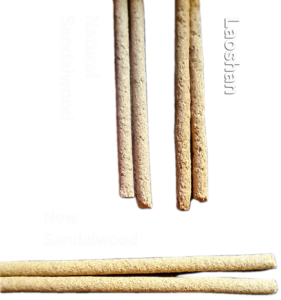
With so few samples, a detailed comparison was hardly possible. But I can say this much:
Natural Sandalwood is the weakest of the three for me. It has hardly any noteworthy sandalwood character, but simply offers an inoffensive wood smoke smell.
New Sandalwood (the cheapest of the three) have substantially more character to offer and at a far more attractive price.
It’s a full sandalwood fragrance with little sweetness. It has a fine, subtle woody spiciness, as well as the familiar, buttery softness with that slight salty feeling that some sandalwoods offer.
Laoshan Sandalwood (the most expensive of the three) offer a classic, woody-spicy sandalwood fragrance with the milky, soft sweetness associated with Indian sandalwood.
New Sandalwood stand out for me as far as value for money is concerned.
Comparing the Agarwood Varieties
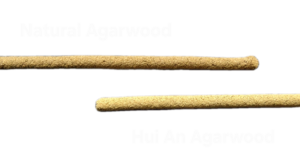
It’s unfortunate that the picture doesn’t convey this well, but Natural Agarwood is notably darker than Hoi An Agarwood.
Hoi An Agarwood seems to have a somewhat clearer, more defined character than Natural Agarwood. I smell a smidgen of the interesting pungent note that I keep smelling in ‘Kinam’ agarwood; although, Hoi An Agarwood have a much more pronounced sweetness.
Natural Agarwood, in comparison, seem much less defined but still round and pleasant. The smell is woodier, slightly balsamic wich a warm sweetness.
Again, with the small number of samples, only a very rudimentary comparison was possible.
Comparing the Jiangzhen Varieties
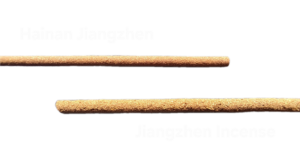
The photo deviates greatly from actual stick colours due to lighting. The scans accompanying the reviews are colour-accurate.
In my online research on jiangzhen wood, I came across this article, which states that jiangzhen is often confused because of a name similarity.
The author considers Acronychia pedunculata to be the correct jiangzhen in the context of incense, whereas Dalbergia odorifera does find use in traditional Chinese medicine but not as incense. – Surprising, I find, given that ‘odorifera’ suggests a plant is fragrant…
In any case, jiangzhen is not a recognized incense material in the West, but in China, it seems to have cultural significance.
Which of these two plants are used for this incense, I can’t say.
I asked Yichen their opinion on the article. Their only reaction: ‘It is difficult to judge’.
The two jiangzhen varieties differ drastically:
Jiangzhen Incense has an almost one-dimensional, relatively simple fragrance. The scent character makes me wonder whether this wood is burnt mainly for reasons of cultural significance and less for its aroma.
Hai’nan Jiangzhen, on the other hand, has a strong, unique character. Besides a deep woodiness, its fragrance has an unusual sweetness and a surprising florality to offer.
Conclusion:
What I like about Yichen
- I like Yichen’s website; I find it clear and well-made.
- Product descriptions are quite detailed and generally offer a bit more than just flowery marketing text.
I particularly appreciate the listing of top, heart and base notes, which you find with most varieties. I’ve found these to be very apt.
That this description is offered bilingually, in Chinese and English, is a nice touch. - The perceived naturalness and quality of most varieties.
- I would have liked to list the provided ingredients lists here too, but as it turned out, these aren’t reliable.
What I don’t like about Yichen
- No weight is given for any of the varieties; they’re sold purely by quantity. This alone isn’t unusual or negative, but what really bothers me is the vague specification of 20-30 or 30-40 sticks, depending on variety. That’s a difference of 25-33 % and with incense sticks that cost up to ~ $40 or €34!
For almost all sticks, only a variable length of 18-21cm is given.
I would like more specific information about the amount I’m receiving for a handmade product that aims to establish itself in the high-end market. - Yichen do provide information about ingredients but use mainly AI-generated images to do so, which moreover aren’t trustworthy according to their own statements. (See Goose-Pear Incense).
The ingredients lists are furthermore not complete for at least some varieties, which leaves open the question of which lists actually are.
It was hard for me to judge whether Yichen’s reserved information regarding ingredients came from unwillingness or ignorance. - Yichen’s attitude.
Admittedly: as a normal customer, you wouldn’t have noticed any of this, but it was part of my experience with them, and unfortunately, it made me dislike Yichen them to a fair extent. You’re welcome to see the details in the section below.
My Personal Experience with Yichen
Yichen contacted me before the end of my last review season and asked me how I usually cooperate with incense suppliers.
Whereupon I sent them a link to my Guidelines for Vendors and Manufacturers, which contain all the important information about this; including the minimum number of samples I need for a proper review. If they were happy with that, they were welcome to send me samples.
There followed a longer conversation, in the course of which they had some questions about the ‘follower count’ of my blog, which I answered with current screenshots of my statistics.
I was told they’d like to send me some samples, and they got my address.
In the further conversation, they (alongside plenty of small talk) got tips on packaging incense sticks for international shipping and mentioned that they’d like to learn more about the international market.
I recommended they read the posts on Reddit r/Incense to learn more about the interests of customers in the West.
Doing that, I gave a clear warning not to try to post advertisements there, as it violated the rules of r/Incense and these rules were enforced very strictly.
Later I had to learn that they’d apparently made a Reddit account straight during our conversation and tried to publish 2 advertisement posts on r/Incense. 😐 (These were, of course, deleted immediately; the account was banned right away.)
Then, the next day, they suddenly said they normally don’t give out free samples because they had made bad experiences with that in the past.
Instead, I was asked whether I’d be interested in buying the sample sets; they would give me a $5 coupon.
I explained to them that that wasn’t an option for me, as I have more than enough incense still waiting for a review. They weren’t the first company to try to get me to buy their incense and get reviews on top of that.
I told them they didn’t have to send me anything; it would be totally up to them whether they wanted to send me samples or not.
In any case, I’d wish them the best of luck.
Yichen then made an instant U-turn; suddenly it wasn’t at all a problem to send me samples. 🙄
Honestly: I’m mad with myself that I didn’t draw a line there and decline the samples.
At that point, I was simply too fed up with their behaviour and had no desire for further discussion.
So, they shipped the samples; tracking was available, there were no customs problems, everything went smoothly.
When unpacking, it quickly became clear to me that they either ignored my conditions, as laid out in my Guidelines for Vendors and Manufacturers, or probably hadn’t even bothered to read them in the first place. The samples were tiny and barely sufficient for a decent review.
I stuck my nose into a few varieties last year, but the majority—as expected— hat to wait until 2026, as my review season was coming to an end.
This didn’t stop Yichen from asking me now and then about the progress, ignoring the information about my review break during the cold season that I’d already pointed out to them.
They even went so far as to tell me in early February that they had ’sent samples to many people’ and ’all of them have shared sincere and thoughtful feedback‘ since.
Which is an interesting statement, having previously complained about their bad experiences and said they wouldn’t give out samples any more because of that. And that in February—a good month+ before my review season begins, which I’d told them multiple times. 🤬
The whole situation kept me in a limbo state between curiosity about Yichen’s incense and irritation at their attitude (which wasn’t necessarily helpful to the progress of the reviews).
The only Chinese incense sticks I had previously tried came from AliExpress. The thought of being able to work directly with a Chinese manufacturer and possibly gain interesting insights from that was appealing.
The communication, however, proved to be altogether very unsatisfying.
At one point, it even crossed my mind to throw the stuff away and block Yichen, but that’s neither my style nor in line with my love for incense or my rejection of wastefulness.
You could say this article was born out of spite; from my itch to write about interesting incense, and at the same time to shine some light behind the scenes and on the behaviour of certain companies.
With the completion of this article, I’m done with Yichen.
The lesson I draw from this experience is to say ‘no’ in good time.
Good review; my big question about this brand was how the rose was handled. It’s a shame to hear that it’s another burning-plant rose stick. I’m surprised to hear how clean the mugwort was. I’ll have to try some mugwort incense at some point. It’s crazy to me that the samples came in a 3D printed box; those must take forever to make!
Also, it’s pretty embarrassing that they tried to nickel and dime you for a handful of sticks, and then complained when a review wasn’t forthcoming—especially when they approached you in the first place! An unfortunate number of small business owners are like this: cheap, and with gall by the bucketful.