
Awaji Baikundo – Agarwood Hanamizuki · 沈香花水木
This box was passed on to me (half full) by my friend Povilas. He cleared out his collection mid-2024 and passed me on a couple he no longer used.
I was long uncertain about the name of these incense sticks. Povilas didn’t know exactly what they were called either. He’d bought them via eBay and only knew they came from Awaji Baikundo.
First I found them in Awaji Baikundo’s (Japanese) PDF catalogue, at page 3.
Awaji Baikundo’s auto-translated, Japanese website calls them Jinkou Hanamizuki. Translators offer different, sometimes very absurd translations such as ‘flower water tree’. However, Hanamizuki seems to mean dogwood. To my knowledge, it finds no use in incense.
Today I searched a bit more and found them in the internationally shipping Japanese shop Wa no Kaori. They are called Agarwood Hanamizuki there. The description text explains that the fragrance is inspired by the blossoms of the dogwood, of which there’s a species indigenous to Japan.
Thus, Agarwood Hanamizuki are incense sticks based on agarwood, and inspired by a flowering shrub, just as there are Japanese ‘cherry blossom’ or ‘plum blossom’ incense sticks.
Agarwood Hanamizuki aren’t available in Germany, and I haven’t been able to find them anywhere else outside Japan either.
Apart from at Awaji Baikundo‘s own shop, I only find them in Wa no Kaori‘s range. A box like this, with 30g contents, costs €14.95 plus delivery (from Japan) and any customs fees that may apply. The sticks are 14cm long and each burns for approximately 30 minutes.
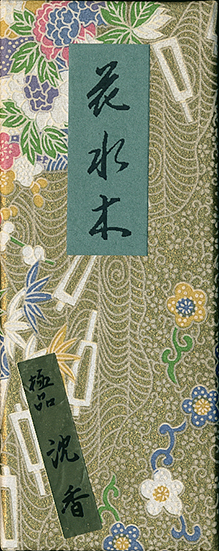
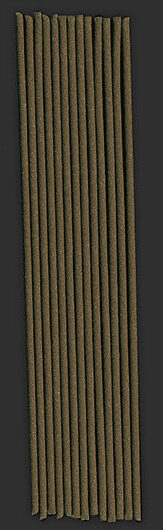
The blue sticker on the box tells the name ‘Hanamizuki‘; the gold sticker reads ‘agarwood of highest quality’.
The raw sticks have a rather weak smell. Aromatic, but somehow dull. It’s a rather dark smell that sits somewhere between sour and umami.
The first time lighting, Agarwood Hanamizuki smelt only of smoke to me, and that improved only minimally for a long time. For me, these sticks had a really long learning curve.
I didn’t take out Agarwood Hanamizuki often, but every few weeks or months, I gave them another try to see if my perception would change.
First, I could perceive a certain spiciness in the smell, which quickly became unpleasant.
Gradually I started smelling an agarwood note, which I, however, found to be very thin and woody-dry. For me, it was still rather a smoky smell.
Nothing much changed for a long time. Only one aspect (which I still find rather unpleasant) took on somewhat clearer form: there’s a small note of ‘wet dog’.
About a year later, I could find a fine sweetness in the sticks for the first time, and the agarwood character gradually became more apparent.
The spiciness initially felt scratchy, I now perceive as part of the agarwood smell. It’s a slightly pungent note that can feel fresh or even green in the right dilution.
Nevertheless, Agarwood Hanamizuki remains rather dry, tending towards warm wood smell.
Their sweetness is unsteady. When I light a stick and sit in my usual place (approximately 2m away), the first thing that reaches me is a promising sweetness with relatively full agarwood aroma, but just a few breaths later, the smell flattens out and becomes duller.
When I walk through the room, I sometimes smell more of the pungent spiciness, sometimes more of a warm, almost waxy note (which can intensify to ‘wet dog’), but the fragrance overall remains rather unremarkable; it fails to excite me.
Even with much patience, I haven’t warmed to Agarwood Hanamizuki. I don’t find them bad, but like Povilas, I have so many alternatives I prefer that the box just gathers dust.
I’ll therefore pass them on; Nathan, to whom I’ve had sent some samples, has taken a liking to them.
Awaji Baikundo describe Agarwood Hanamizuki as everyday incense sticks well suited to people who don’t like perfumed smells.
The fragrance of Agarwood Hanamizuki indeed feels very natural and unperfumed.
Anyone with a liking for dry wood smells can certainly do more with them than I can.