
Al Haramain – Agarwood Cambodia
This sample Agarwood Cambodia comes from my friend Povilas, who sent it to me together with a large selection of bakhoors.
Actually, I perceived and categorised the wood as bakhoor, as it’s sold by Al Haramain, a brand for perfume and bakhoor in the United Arab Emirates. Furthermore, doesn’t really look natural.
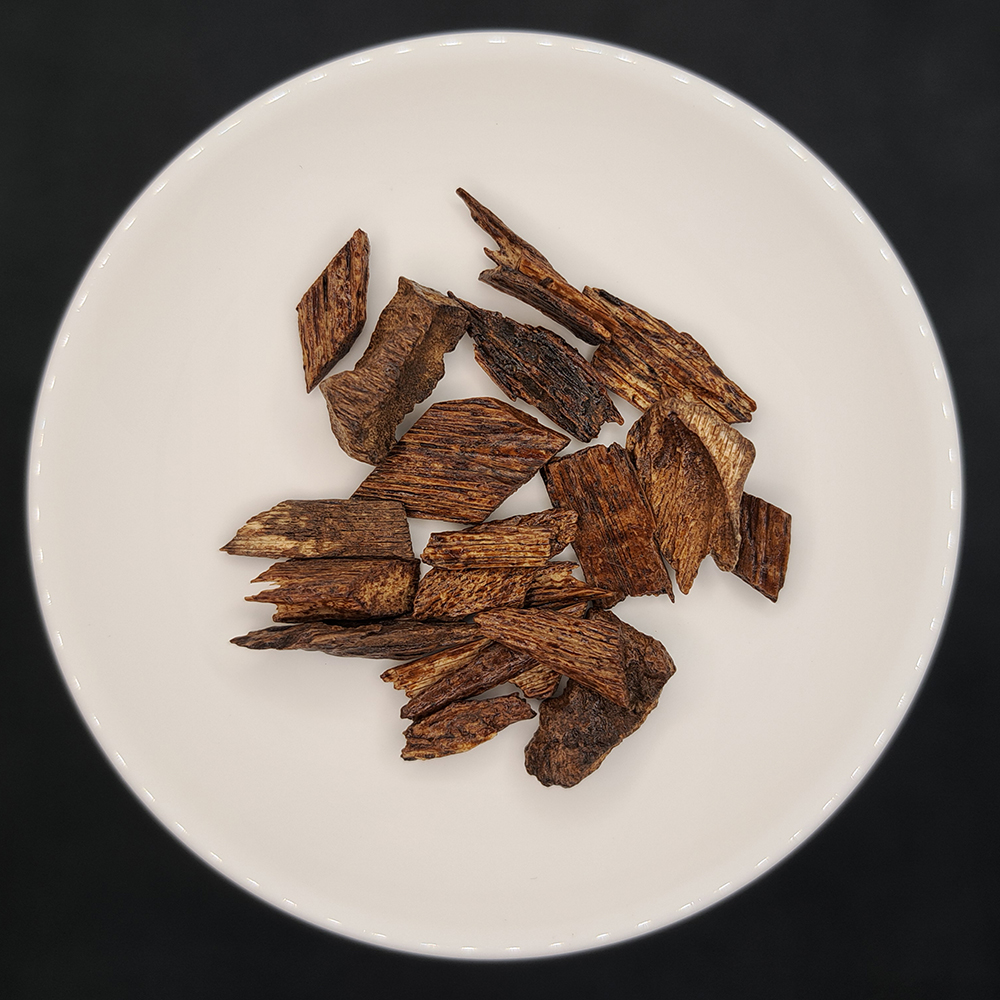
Agarwood Cambodia is sold by Al Haramain in four pack sizes: 25g, 50g, 100g and 200g.
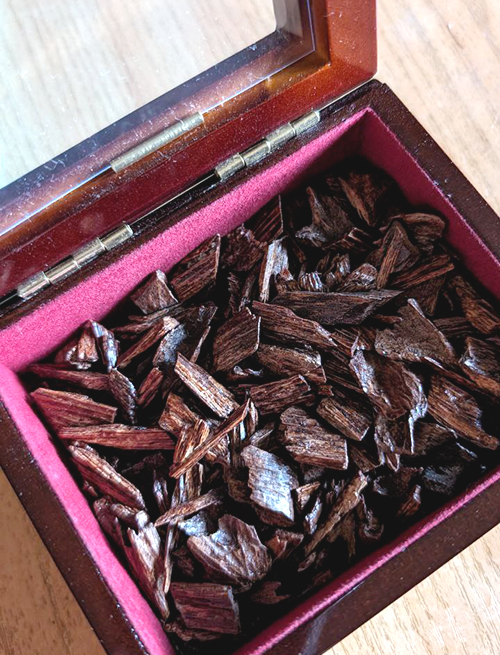
The chips are packaged in wooden caskets with a glass window and magnetic closure lid.
The prices are given in USD and range between 1.47 and 0.86 dollars per gram, depending on box size.
The description in the Al Haramain shop reads as follows:
Agarwood Combodi offers you an exquisite selection of natural oud chips sourced from the heart of Cambodia’s ancient forests. Known for its deep, resinous aroma and warmth, this oud provides a rich sensory experience with every burning. It’s excellent as a luxurious gift or as a lovely addition to your incense collection. Haramain Agarwood Combodi is the most authentic oud.
Here you can see a 50g casket with contents:
Thanks to Povilas for providing the photo.
Besides this Agarwood Cambodia, Al Haramain also sell a ‘Cambodia Agarwood‘ that’s a little more expensive, and a ‘Cambodia Super Agarwood‘, of which 50g cost $271.43.
Overall, I see 16 different agarwood varieties available in the shop, including these three ‘Cambodia’ variants.
I mentioned at the beginning that the wood chips don’t look natural to me, and here you can see what I mean:
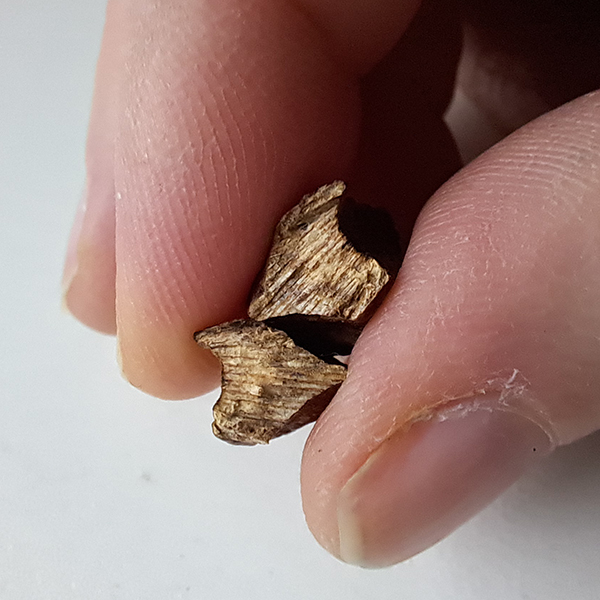
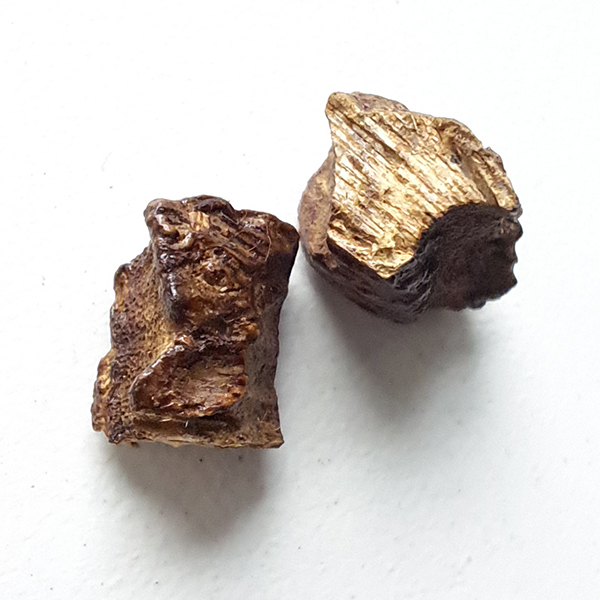
When you break the pieces, they’re noticeably lighter on the inside than outside, and the surface has a certain shine.
In the title picture, you can also clearly make out notable spots on some chips. The look reminds me of glaze on wood.
I’ve heard that inferior agarwood can be enhanced with ‘agarwood resin’; a substance that is generated as a by-product when distilling agarwood oil.
Possibly, that’s happened here?
I want to emphasise that I’m anything but an ‘agarwood specialist’; so please see what’s written for what it is: the speculation of a layperson.
On the tealight warmer, it’s not too easy to hit the perfect temperature for this material. It definitely needs more heat than many of the bakhoors and a number of other incense materials, but if it gets too hot, Agarwood Cambodia quickly smells harsh.
I place a little piece of it directly on the sieve instead of placing it on a glass cover sheet (as a cheap replacement for a mica plate), in such a way that it’s not directly over the heat jet of the flame but slightly to the side of it.
In this way, the wood gives off a deep, dark aroma, interwoven with a leathery note and hints of a slightly pungent spiciness. The fragrance is balsamically soft and slightly sweet. It’s a complex fragrance that reminds me a bit of labdanum but even more of poplar buds.
Different associations appear, like mildly fruity and vanilla-like pipe tobacco, but also the tart-aromatic aroma of propolis.
The scent is partially influenced by my distance from the incense warmer: the further in the room and away from the source I am, the rounder and sweeter the fragrance appears; the closer my nose comes to the warmer, the more clearly I notice the rather tart notes, the leathery character and pungent spice about the smell.
These two aspects are what shifts into the negative with too much heat. What in dilution manages to recall leather in an interesting way, smells harsh and bitter then; of the spiciness, only the pungent sensation remains. Mixed with the sweetness, these notes remind me of hot plastic.
Nevertheless, I have to say that I find the fragrance quite attractive in good conditions. The balsamic depth is captivating and has an immensely relaxing effect on me.
It’s a marvellous companion for quiet evening hours with dimmed light, when you leave the world outside the door.
I’ve also grown fond of the fragrance for my bedroom. There, I use it on my electric incense heater (from AliExpress) at between 240 and 280 degrees.