
Minorien – Fu-In – Byakudan (Sandalwood)
Minorien – Fu-In – Byakudan has long been recommended as the Japanese sandalwood incense stick with the best cost-to-quality ratio. In fact, it falls into the price range of everyday incense sticks, at least when you look at the original price in Japan.
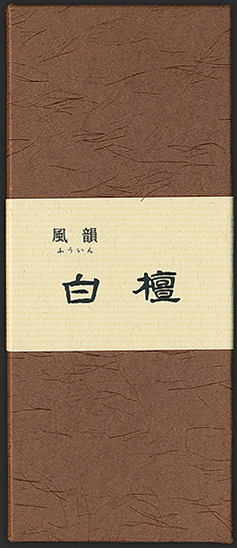
The internationally shipping shop Wa no Kaori sells a 45g box (as in the title image) with about 150 of the 14cm-long sticks for €12.95. If you have the chance to buy directly in Japan, you pay even less.
In the West, prices are notably higher: in England they’re sold by Lotus Zen for about £39;
in the USA you pay $31.99 (roughly €28).
In Germany, unfortunately, they’re not available at all so far. However, you can occasionally find listings on eBay, shipping from England for around €15 or having shipping costs already included. With those, you can easily end up paying around €50-60 for a box like this.
Since around 2021/2022 I’ve seen comments stating that the formula of Fu-In Sandalwood has been changed and the sticks are now not as good as they used to be, or even not worth it anymore.
Nevertheless, they’re still recommended in practically every Reddit thread on r/Incense that asks for good sandalwood sticks.
So what’s the going on? Do the people recommending them still have leftover stock of the old version and don’t know about the change? Are those who know Fu-In Sandalwood from before simply too disappointed by the current version to give it a chance? Is the new Fu-In Sandalwood actually bad?
Naturally, I was curious about Fu-In Sandalwood and wanted to form my own opinion on both. This year (2026) it happened that I was able to compare a couple of years old sticks with a sample of much younger ones.
The 45g box in the title image was a gift from Michael, who I met on Reddit. They come from a lot that was sold on eBay a few years ago by a pawnshop (in America).
Not long after I got these, a listing popped up on Kleinanzeigen of someone selling a selection of sample packs from the Singapore-based shop Atmosphere. Among them were a sample of 6 sticks of Fu-In Sandalwood, from a 2025 order.
So, let’s take a look at the sticks from both batches and compare them:


Minorien – Fu-In – Sandalwood,
sample, sold 2025 by Atmosphere
The raw incense sticks have a rich, pleasant sandalwood smell; very woody, with a slight sweetness and plenty of the typical softness.
The lit sticks burn with a soft, woody sandalwood aroma. Although I don’t really find the scent sweet, it’s definitely not one of those woody dry sandalwood smells.
To me, the scent is well-rounded and pleasant.
In the room, Fu-In Sandalwood spreads in a rather subtle way, but doesn’t get lost in it.

Minorien – Fu-In – Sandalwood, from around 2020
The cold throw of this older version of Fu-In Sandalwood was already detectable when I opened the package it arrived in. It’s a very full, robust sandalwood smell for Japanese sticks. Essentially, it’s the same as of the newer batch, but stronger and with a rich butteriness.
From the start of the burn, the sticks of the old Fu-In Sandalwood show themselves to be noticeably more robust and richer in smell.
Like with the newer ones, the sweetness of the sandalwood sits in the background. The most present feature is a pronounced, soft butteriness.
In my living room, the smell of this several-years-old Fu-In Sandalwood is quite a bit more present than that of the newer batch, and genuinely room-filling.
Conclusion
There’s a rumour circulating on Reddit that packs with the ‘new formula’ carry the writing ‘Sandalwood’ instead of a Japanese ‘白檀’.
This never really made sense to me because why would incense boxes intended for the Japanese market suddenly carry an English label? I suspected these might rather be for export.
To avoid ending this article on pure speculation, I asked Ken from Wa no Kaori what he thought of the claim.
Ken confirmed my suspicion. He’s convinced that the English-labelled boxes must be export packs, which, to his knowledge, contain the same incense as the Japanese ones. In Japan, no change to the packaging has taken place; they still sell the ones with Japanese characters.
Beyond that, Ken questioned the entire theory of a reformulation. He said there had never been an official statement from Minorien. He told me, he would expect a formula change to extend across the entire line and actually come along with a redesign of the packaging.
To back up his argument, he combed through the review sections of several major Japanese sales platforms for indications of changes and found nothing. Not a single review complaining about a changed smell or inferior quality.
I have to admit that up to that point, I had treated the reformulation as fact, but this conversation has made me more than a little doubtful.
But where did these rumours of a reformulation come from?
Reddit, or rather r/Incense, is a bubble; an echo chamber in which opinions are quickly taken at face value. They’re all too often repeated uncritically and thereby amplified, until they’re accepted as fact by the general public. And in this case, I’ve clearly become part of that feedback loop myself.
Given that the forum has a particularly large number of US users, the American market naturally shapes its image.
Looking at the situation afresh, the most obvious conclusion is that the change took place on the American market—But how could that be?
In the USA there are two major specialist retailers for Japanese incense: Kikoh Incense and Japan Incense. Kikoh has only existed since 2017 and, by their own account, initially only sold “the three most well-known Japanese brands available in the US” (which are likely Nippon Kodo, Shoyeido, and a third, possibly Baieido).
Around 2020/2021, Japan Incense was definitely still the best-known and dominant retailer; they started the online shop in 2006 and run a brick-and-mortar store (called Kohshi) in San Francisco for even longer.
I have no insight into how these shops operate, or how large their stock might be, but it stands to reason that they buy as large batches as possible to keep shipping costs from Japan low.
From German incense retailers I know that stock can well last for years.
Properly stored incense sticks of good quality don’t go bad, they mature. Minorien write in their description of the Fu-In line: “[…] the scent may become more mellow over time as it matures”. Furthermore, they point out that, due to the naturalness of the ingredients used, subtle differences are to be expected.
My theory is as follows:
A large stock of Fu-In Sandalwood, properly stored, possibly matures over years in the warehouse of a US incense dealer, and customers would keep buying from that same stock throughout that time. They’d always get the same sticks, providing a consistent scent experience.
If that stock ran out and was replaced by a fresh batch, the difference would probably be drastic enough to be interpreted as a reformulation. If this new batch then also arrived, unlike before, in export packaging, that would, of course, reinforce this interpretation even further.
In an attempt to test my theory’s plausibility, I reached out to Japan Incense; unfortunately they didn’t respond to my email.
I can’t rule out that there was a small change to the formula of Fu-In Sandalwood after all, but based on what I currently know, I consider it rather unlikely.
The only thing I can say with certainty is that there’s a clear difference between the older and newer sticks of Fu-In Sandalwood.
If you’re confronted with this difference out of the blue, disappointment and frustration are understandable, as the old sticks are fantastic.
Still, I consider the newer ones excellent as well, and compared to other Japanese (and also Chinese) sandalwood incense sticks I’ve tried, I liked them the best.
If you don’t know the old ones, you can fall in love with the new ones just as much, and it doesn’t surprise me that they’re still recommended, even if there actually was a change to the formula.