
Yamadamatsu – Rakuen (Sampler)
Sebastian brought me this sampler as a gift from his trip to Japan. Thanks again for that!
The sampler contains 4 sticks each of the 3 varieties from the Rakuen line (sometimes also spelled Raku-en).
They’re 7cm long (at a thickness of 2mm), which matches the full length of the regular packs.
The burn time is given as 15-20 minutes.
The varieties included are: Fujitsubo · 藤壺 (Wisteria Vase), Hagitsubo · 壺庭 (Hagi Vase) and Seiryo · 清涼 (Bracing).
The sticks are available in packs of 20, with a holder, or packs of 60 without.
I haven’t found a source for sticks from this line in Germany. Lotus Zen (UK) don’t currently sell them either.
Online, I’ve so far only been able to track down the sampler at Wa No Kaori (Japan, international shipping). There it costs €4.95.
The small packs of the individual varieties cost €7.95; the large ones €15.95.
Taking a look at the Yamadamatsu website, I notice that Rakuen is also available as incense coils, and for those, two additional varieties are listed: Gyoka and Shoyo. The varieties of the sampler are sandalwood-based, while the other two have agarwood as their base material.
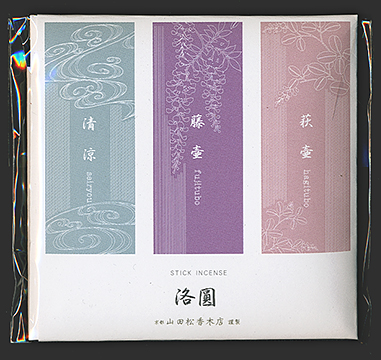
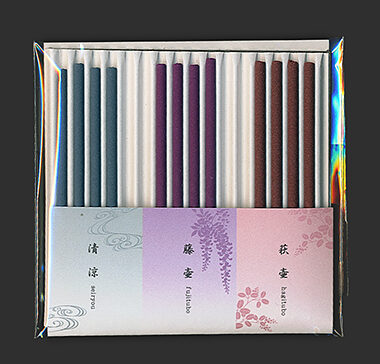
The sampler is wrapped in thick paper. Inside is a second plastic package with the sticks (left), separated by corrugated cardboard.
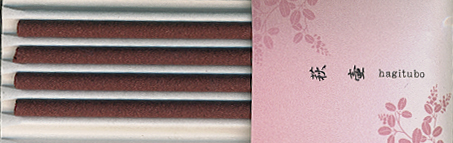
Hagitsubo
Written as ‘Hagitsubo‘ or ‘Hagitubo‘.
Nathan has often described the smell of camphor, or borneol, as ‘frozen onions’, which I always found curious. I didn’t quite understand what he meant, at least until this sampler. Although clearly recognisable as camphor, the smell of the raw sticks actually has a striking resemblance to that of frozen diced onions.
Alongside that there’s a slight spiciness and a tiny soapy note.
Lit, the sandalwood base comes through very clearly. There’s a soft, slightly creamy and sweet sandalwood scent in the background. The dominant aroma I’d describe as rather tart, and musky with a soapy edge.
The camphor contributes slightly to the perceived tartness of the scent, but also loosens it up a little.
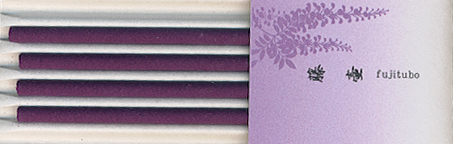
Fujitsubo
Written as ‘Fujitsubo‘ or ‘Fujitubo‘.
The raw smell is strongly camphorous and even more ‘oniony’ than that of Hagitsubo, but lets a sweet florality shine through.
Lit, a sweet and floral scent spreads, which I find very creamy. The scent reminds me of Indian incense sticks, something from Mother’s, perhaps. On top of that, a woody, sweet-creamy note keeps appearing, which makes me think of Chandan (sandalwood) incense sticks.
The camphor is still noticeable as a faintly tart, fresh note, which lifts the smell overall. I find it a bit too pronounced, but since camphor is volatile, and these sticks are quite fresh, I’d assume this aspect will weaken over time.
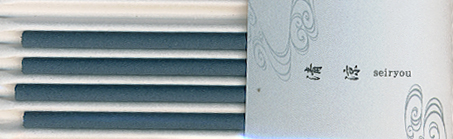
Seiryo
Written as ‘Seiryo‘ or ‘Seiryou‘.
The raw smell has the same camphor character as the others, mixed with spicy notes (mainly clove) and a distinct sweetness.
With Seiryo, a strong sweetness and creaminess mixes into the camphor freshness once again. The sandalwood of the base is once more fairly noticeable, but this time in combination with a stronger spiciness than in Hagitsubo. I find the two fairly similar, though Seiryo perhaps comes across as a bit fresher.
In the after-smell this becomes a little more apparent.
Conclusion
Although I generally appreciate the Yamadamatsu brand a lot, I’m not overly enthusiastic about Rakuen. I should note, though, that this is the first modern and floral line from Yamadamatsu that I’ve tried.
The scents are by no means bad. They don’t seem to be based purely on perfumes, and I find no off-notes. The scents just don’t quite match my taste.
Of the three, I liked Fujitsubo best, but I don’t think I’d buy a pack of it. If anything, this sample has made me curious to try more Japanese wisteria incenses.