
Baieido: Tokusen Kobunboku, Kaden Kobunboku
I got samples of both varieties from the Kobunboku line from my friend Povilas in 2024; I later additionally bought a small box of Tokusen Kobunboku second-hand.
The two varieties are available in different pack sizes up to 170g; the sticks measure 5½″ (approximately 14cm) with a thickness of approximately 2mm. There’s also a long format with 25cm.
In Germany, Baieido can only be found in few shops, for example at Padma Store or Klang & Stille.
Kobunboku means plum tree.
Alongside the two varieties presented here, there’s also Bikou Kobunboku, Byakudan Kobunboku, Jinkou Kobunboku and the basic version Kobunboku itself.

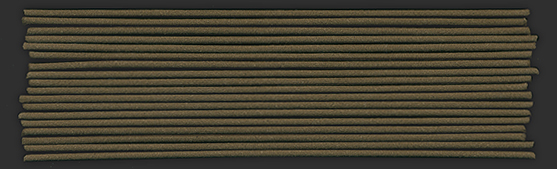
Tokusen (Excellent) Kobunboku
Tokusen Kobunboku is occasionally called Excellent Kobunboku in different shops.
Padma Store sells a small box with 10g or 26 sticks for €6.85; the large box with 170g (450 sticks) is available for €59.
Anyone willing to order directly from Japan pays only €23.95 at Wa no Kaori for the large box (plus delivery and any customs charges).
I find slightly differing information about the ingredients. Baieido only mentions a mixture of 15 ingredients, including sandalwood and agarwood. Other shops additionally name borneol, clove, cinnamon, anise, benzoin and Chinese medicinal herbs.
Tokusen Kobunboku belong to the incense sticks that initially smelt very smoky to me, and it took quite a while before I developed a feeling for them, for their character. They might have had the longest learning curve so far.
One of the first things I could smell out was the camphor. But even after Tokusen Kobunboku had stopped smelling mainly of smoke to me, my impression remained diffuse for a long time.
Woody notes came to the fore occasionally; every now and then, a vague impression of spices. This is mixed with a light acidity and a sort of umami note. Added to that, I often smelled a waxy tone and over time I could perceive a subtle sweetness.
At some point, I started burning the version below named Kaden, and I think this gave my nose somewhat more context; something I could compare and contrast the fragrance to.
Since then, I’ve found Tokusen Kobunboku somewhat more robust and defined than before, but still not quite tangible. This might be because the weather has a considerable influence on the character of this fragrance.
To my great surprise, I discovered that Tokusen Kobunboku (and other Baieido varieties as well) perform excellently with very hot weather. (During the last heat wave, with sitting temperatures of 35°C, I burnt almost exclusively a rotation of the two Kobunboku varieties and Kaiunkoh.)
In the heat, I find the fragrance not directly refreshing, but somehow cooling. The camphor certainly contributes to that, but it’s also the sour note. Normally, I don’t particularly like this, often I even find it irritating, but in the heat it started to seem fresh in a certain way.
Occasionally, I can now recognise cinnamon in the spices and I find a hint of agarwood.
Time and again, I land on the description ‘umami’. It’s not really a food or kitchen smell, but that’s still the most fitting thing that comes to mind.

Kaden Kobunboku
Kaden means ‘old family secret’. In this version of Kobunboku, Vietnamese agarwood has been added to the recipe. Some shops call it ‘Tsukigase agarwood’, but I couldn’t find out what’s behind the term.
Ingredients: Tsukigase agarwood from Vietnam; sandalwood, borneol, clove, cinnamon and others (it’s said to be a total of 20 ingredients).
With Kaden Kobunboku, it feels almost as if my learning curve were running backwards. Initially, I was very surprised to read that many people perceive the variety as smelling similarly smoky as Kaiunkoh because I didn’t at all.
In comparison to the Tokusen version, but also overall, I find Kaden Kobunboku rather mild in its intensity. The smell has less volume than that of Tokusen Kobunboku.
I find many parallels to Tokusen Kobunboku though: camphor, a waxy note, the special acidity, but everything comes across weaker in Kaden Kobunboku.
In Kaden Kobunboku I smell a fine bitter note that, after a few sessions, revealed itself to me as bitter agarwood smell. Occasionally, the scent also has a medicinal character, not directly iodine-like, but somewhere in that ballpark.
As with Tokusen Kobunboku, I initially struggled to gain a clear impression of the smell.
With Kaden Kobunboku, though, I discovered that it makes a big difference if I don’t burn the stick (as usual) at approximately 2m distance in my living room, but rather in the adjacent room and let the fragrance drift to me (with open doors and windows).
That’s how I discovered the above-mentioned acidity. Additionally, I can perceive a herbaceous aspect that plays a bit into the medicinal character.
I’ve also caught a buttery sandalwood note and a hint of cinnamon.
When I’m in the same room as the burning stick, the smell isn’t really smoky but has a certain burnt tone, like the general burnt smell that burning herbs brings with it.
In less hot weather (around 20°C), the deeper, bitter-aromatic notes seem to come to the fore, whilst in the heat the acidity is emphasised.
Conclusion
Baieido are known for their traditional fragrance profiles. I don’t think I can yet distinguish what’s Baieido’s style and what’s the general, traditionally Japanese character. Perhaps that’s not even possible to separate.
Although I’ve come to like Tokusen Kobunboku more than at the start, I still haven’t really grown fond of them. I’ll certainly use them up, but I don’t think I’ll buy another pack.
The same applies to Kaden Kobunboku, which I simply find more compared to Tokusen Kobunboku.
Apart from the sandalwood variant of Kobunboku (Byakudan), I have no interest in further exploring the Kobunboku line.
I have a feeling, that Baieido overall isn’t quite my thing.
Nevertheless, I’d say you can’t get past Baieido if you want to explore Japanese incense sticks.